The History of Emojis: From Japan to Global Phenomenon
February 14, 2026 · Bas Hennekam
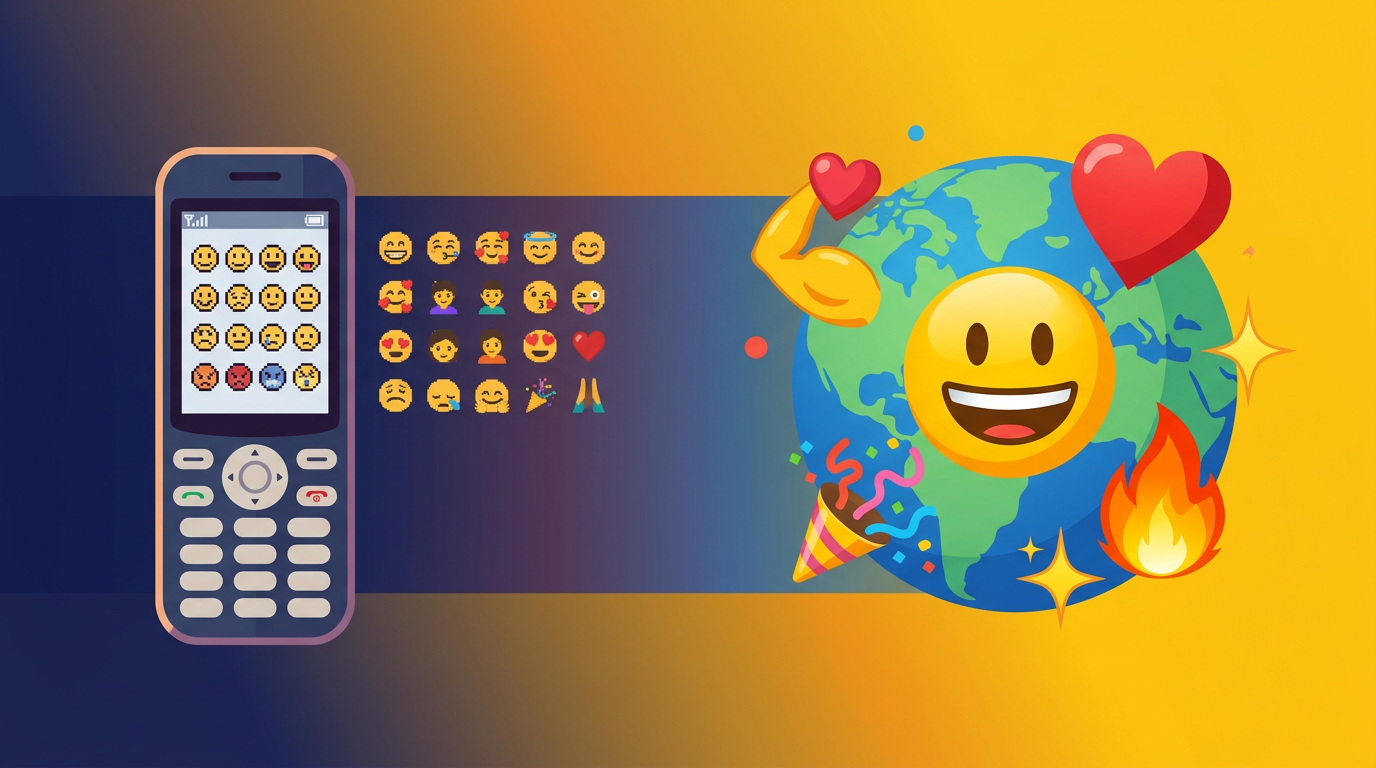
In 1999, Japanese artist Shigetaka Kurita sat at his desk at NTT DoCoMo, one of Japan's largest mobile carriers, sketching out 176 tiny 12-by-12 pixel icons. He probably didn't realize he was about to change the way the entire world communicates. Those 176 simple drawings (hearts, smiley faces, weather symbols) were the very first emojis.
The Problem That Started It All
Before emojis, Japanese mobile users relied on a feature called "kaomoji," text-based emoticons like (^_^) and (╥_╥) that used characters to form facial expressions. While creative, they were limited. NTT DoCoMo's i-mode mobile internet service needed a way to make digital communication feel more human, more expressive. Kurita's solution was elegant: a set of small pictographs that could convey emotion, weather, traffic, and everyday objects in a single character.
The word "emoji" itself comes from the Japanese 絵文字, where 絵 (e) means "picture" and 文字 (moji) means "character." Despite the resemblance, it has no linguistic connection to the English word "emotion."
The Unicode Turning Point
For nearly a decade, emojis remained a Japanese phenomenon. Different carriers had their own incompatible emoji sets, and the symbols couldn't cross borders. Everything changed in 2010 when the Unicode Consortium, the organization responsible for text standards across all computing platforms, officially incorporated emoji into the Unicode Standard.
This was the moment emojis went global. With Unicode backing, Apple added an emoji keyboard to iOS in 2011 (initially hidden, intended for the Japanese market), and Android followed shortly after. Once Western users discovered the hidden keyboard, there was no going back.
The Explosion of Diversity
The original 176 emojis were charming but limited. As emoji usage exploded worldwide, so did the demand for greater representation. Some landmark additions include:
- 2015: Skin tone modifiers arrived, allowing users to choose from five skin tone options for human emojis, based on the Fitzpatrick scale used in dermatology.
- 2016: Gender-inclusive emojis were introduced, adding female versions of professions like 👩🔬 scientist and 👩🚒 firefighter.
- 2017: Hijab emoji 🧕, breastfeeding emoji 🤱, and various cultural additions.
- 2019: Accessibility emojis including wheelchairs, prosthetic limbs, hearing aids, and guide dogs.
- 2020: The transgender flag 🏳️⚧️ and gender-neutral options.
Today, there are over 3,600 emojis in the Unicode Standard, with new ones added annually after a rigorous proposal and review process.
Emojis in Culture and Language
Emojis have transcended simple digital decoration. In 2015, Oxford Dictionaries named 😂 (Face with Tears of Joy) as its Word of the Year, the first time a pictograph received the honor. Studies from linguistics departments worldwide have explored how emojis function as a new form of punctuation, tone indicators, and even a proto-language.
Museums have taken notice too. The Museum of Modern Art (MoMA) in New York acquired Kurita's original 176 emoji set in 2016, recognizing them as a significant work of design. The Victoria and Albert Museum and the Smithsonian have also featured emoji-related exhibits.
In legal contexts, emojis have appeared in court cases around the world, where judges must interpret whether a 👍 constitutes agreement to a contract or a 🔫 represents a genuine threat.
The Business of Emojis
What started as a communication tool has become a multi-billion-dollar ecosystem. Custom emoji sticker packs, branded emojis for marketing campaigns, and emoji-themed merchandise are everywhere. Companies like Apple, Google, Samsung, and Microsoft each design their own emoji art, leading to the sometimes confusing reality that the same emoji can look quite different across platforms.
World Emoji Day, celebrated on July 17 (the date shown on the 📅 calendar emoji on Apple devices), has become an annual cultural event, with brands and public figures participating in emoji-related campaigns.
What's Next?
The future of emojis is evolving beyond static images. Animated emojis, AR emoji avatars, and AI-generated emoji suggestions are already here. The Unicode Consortium continues to review hundreds of proposals each year, balancing cultural representation with the practical limits of an ever-growing character set.
From 176 pixel art sketches in a Tokyo office to a universal language used by over 90% of the world's online population, emojis have come a remarkably long way. And if history is any guide, they're only going to become more integral to how we express ourselves in the digital age.