
Emoji Meanings Across Cultures: How the Same Emoji Can Say Different Things
March 18, 2026 · Bas Hennekam
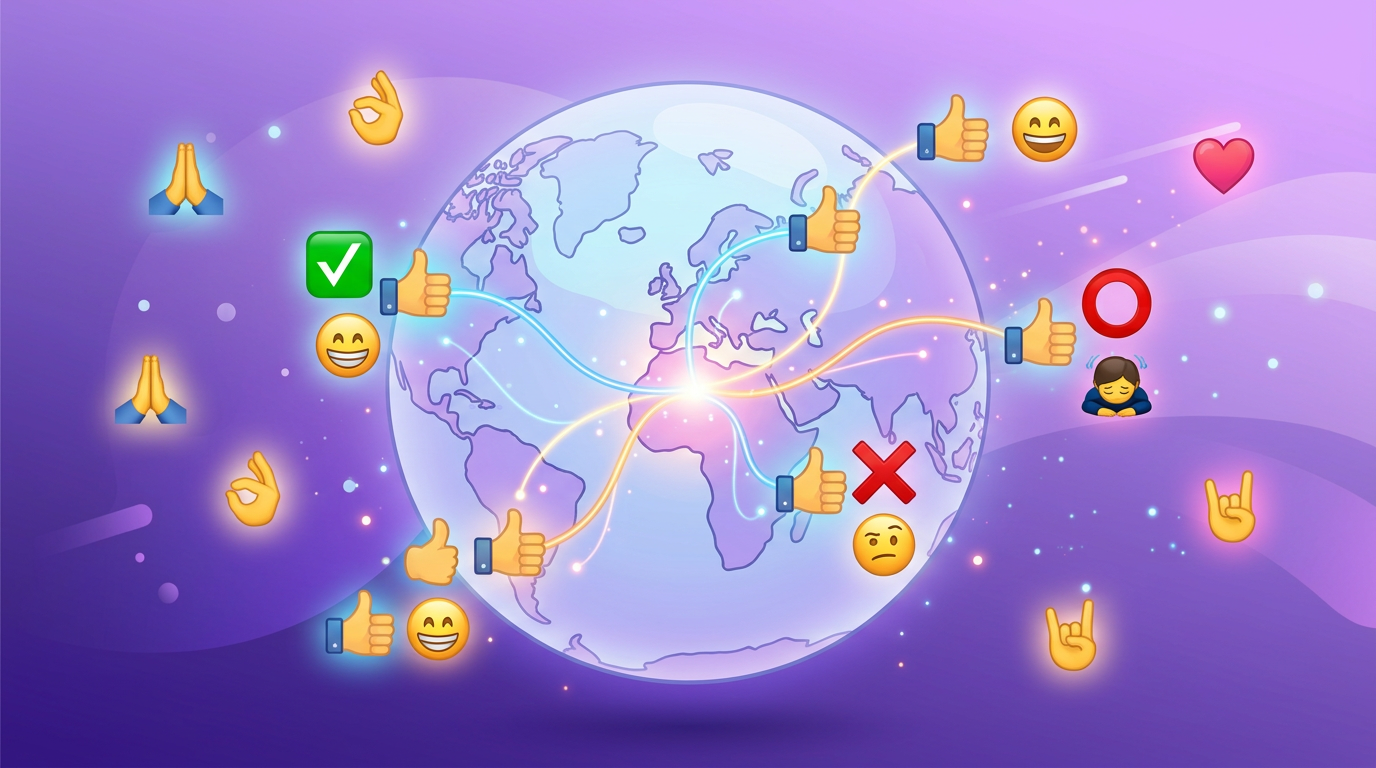
You send a 👍 to confirm a meeting with a colleague in the Middle East. They go silent. You meant "sounds good." They read it as an insult. The thumbs-up gesture, perfectly benign in North America and Europe, carries an offensive connotation in parts of the Middle East, West Africa, and South America, roughly equivalent to a raised middle finger.
This is the hidden complexity of emoji communication. We treat emojis as a universal language, but they're interpreted through deeply local cultural lenses. And as digital communication erases geographic boundaries, these misunderstandings are becoming more common, not less.
One Emoji, Many Meanings
The 🙏 emoji is one of the most culturally ambiguous symbols on any keyboard. In Western countries, most people read it as "prayer" or "please." In Japan, where it originates, it represents a bow of gratitude or apology, not a religious act. In Indian digital culture, it's widely used as a respectful greeting, the equivalent of a namaste.
None of these interpretations are wrong. They're all valid readings shaped by the cultural context of the person sending or receiving the message. But when sender and receiver come from different backgrounds, the gap between intended and perceived meaning can be significant.
The 😂 emoji, officially called "Face with Tears of Joy," was the most used emoji globally for years. Yet even its usage patterns reveal cultural divides. Research from University College London found that users in individualist cultures (the US, UK, Australia) deploy it more freely and in a wider range of contexts, while users in collectivist cultures (Japan, South Korea) tend to reserve it for genuinely humorous situations and rely on softer expressions like 😊 or 🤭 for everyday pleasantness.
The Gesture Problem
Hand gesture emojis are the most culturally treacherous category. Physical gestures vary enormously across regions, and emojis inherit all of that complexity.
The 🤘 "rock on" sign that metalheads flash at concerts means something very different in Mediterranean cultures, where it can imply infidelity. The 👌 OK sign is a positive affirmation in the US but can be read as an obscene gesture in Brazil and Turkey. Even the ✌️ peace sign carries baggage: in the UK and Australia, showing the back of the hand (rather than the palm) while making this gesture is an insult, though the emoji itself doesn't distinguish orientation.
These aren't edge cases. A 2023 study published in the International Journal of Human-Computer Studies found that gesture-based emojis had the highest rate of cross-cultural misinterpretation, with 30% of respondents from non-Western countries reporting they had been confused or offended by a gesture emoji at least once.
Animal Emojis and Symbolic Weight
Animals carry vastly different symbolic meanings across cultures, and their emoji counterparts inherit that weight.
The 🐍 snake emoji reads as danger or betrayal in Western contexts, shaped by the Judeo-Christian tradition of the serpent in Eden. In Hindu culture, snakes represent rebirth and divine energy. In Chinese tradition, the snake is one of twelve zodiac animals, associated with wisdom and intuition. Sending a 🐍 to describe someone is a very different statement depending on who's reading it.
The 🦉 owl is another split. Western cultures associate owls with wisdom, thanks to Athena's companion in Greek mythology. In parts of India, the Middle East, and Latin America, owls are associated with bad luck, death, or foolishness. Calling someone an owl in Hindi (ullu) is a way of calling them stupid.
Even the 🐕 dog emoji carries cultural complexity. Dogs are beloved family members in much of the Western world, but in some cultures they're considered unclean or are associated with insults. "Dog" as a descriptor has sharply negative connotations in several Arabic and East Asian contexts.
Color and Context
The meaning of colors in emojis is not as neutral as it might seem. The ❤️ red heart is broadly understood as love or affection, but the other heart colors diverge quickly.
In South Korea, the 💜 purple heart became deeply associated with BTS and their fanbase, turning it into a symbol of a specific cultural community rather than a generic emoji. The 💚 green heart, innocent enough in most contexts, carries political connotations in countries where green is associated with specific movements or parties. In China, a green hat (🟢🧢) is associated with infidelity, making green-themed emojis potentially awkward in certain contexts.
The Rise of Cultural Emoji Fluency
As remote work and global collaboration become the norm, cultural emoji fluency is becoming a genuine professional skill. Multinational companies like IBM, SAP, and Unilever have started including emoji communication guidelines in their cross-cultural training programs.
The Unicode Consortium, which decides which emojis exist, has acknowledged the problem. Their emoji design guidelines now include notes about cultural sensitivity, and proposals for new emojis are evaluated partly on whether they might cause cross-cultural confusion. The introduction of skin tone modifiers in 2015 was one step toward cultural awareness, letting users represent themselves rather than defaulting to a single yellow standard.
Some platforms are experimenting with contextual emoji dictionaries that surface culture-specific meanings when users hover over an emoji, though this is still in its early stages.
Navigating the Complexity
Awareness is the first step. A few practical guidelines for communicating across cultures with emojis:
- Default to face emojis over gesture emojis. Smiles, frowns, and surprise are more universally understood than hand signs.
- Avoid gesture emojis with people you don't know well. What feels casual to you might feel offensive to them.
- When in doubt, use words. Emojis work best as supplements to clear text, not replacements for it.
- Pay attention to how others use emojis. Mirror your counterpart's emoji style. If they keep things minimal, follow their lead.
A Language Still Evolving
Emojis are often called a universal language, but that's an oversimplification. They're more like a pidgin, a simplified communication system that works well enough most of the time but breaks down at the cultural edges. As emoji adoption continues to grow across every region and demographic, the pressure to bridge these cultural gaps will only increase.
The good news is that awareness is growing too. Every misunderstanding is an opportunity to learn something about how someone else sees the world, one tiny pictograph at a time.