Skull Emoji Meaning: Why 💀 Almost Never Means Death Anymore
August 7, 2026 · Bas Hennekam
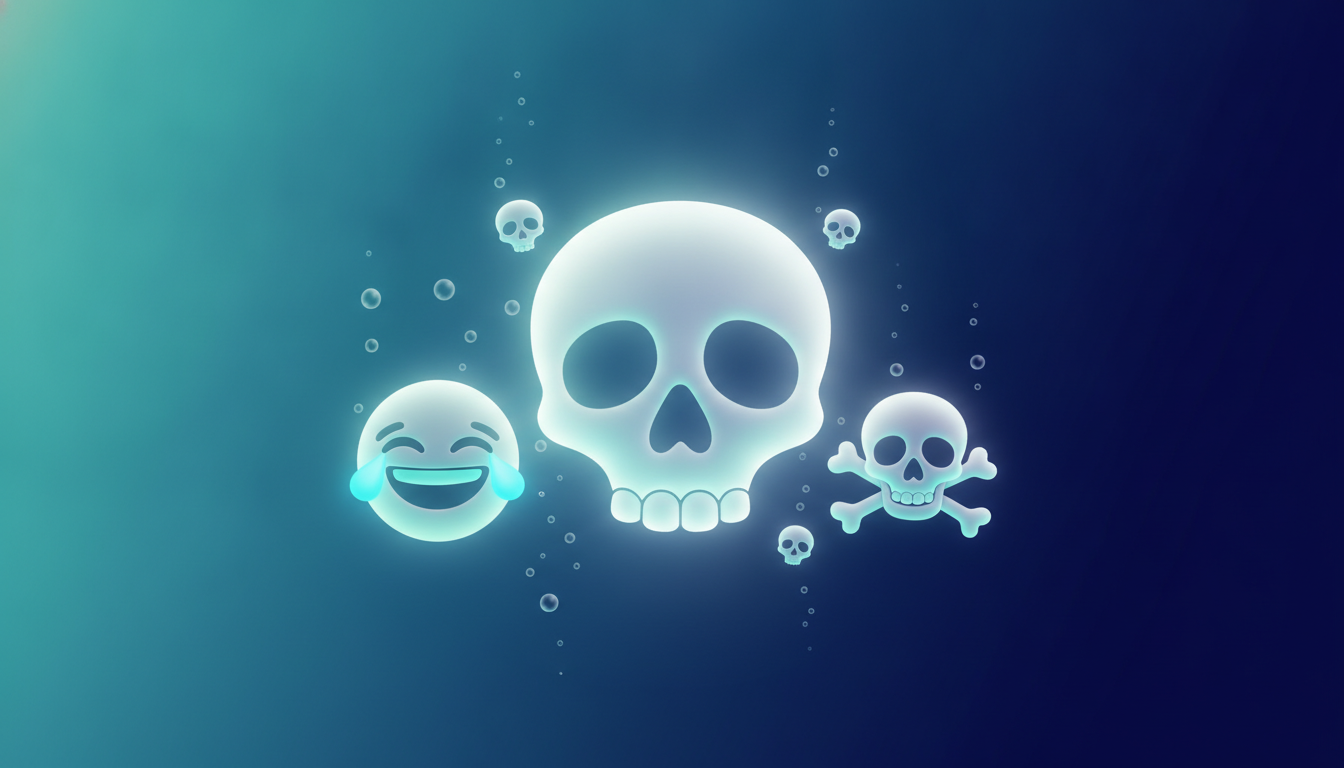
A manager once messaged their team "the client presentation crashed and burned 💀" and spent the next ten minutes fielding concerned replies asking if everything was okay. Nothing was wrong. The manager meant the exact opposite: the moment was so absurd it was funny. That gap between what 💀 looks like and what it means is now one of the most common sources of cross-generational confusion in digital communication, and it deserves its own deep dive. 😅
What the Skull Emoji Actually Means Today
For most people under 30, 💀 does not mean death, danger or anything remotely morbid. It means "I am dead from laughing," a text-based stand-in for a reaction so strong that words fail. Sent alone, in threes, or piled on as a reaction to a message, video or meme, it signals that something is genuinely, uncontrollably funny, often funnier than a standard 😂 could express. Among Gen Z and younger millennials, "💀💀💀" under a post frequently outnumbers every other laughing reaction combined.
That is a complete reversal of the emoji's literal image, and it happened fast.
Where 💀 Actually Comes From
The skull emoji was added in Unicode 6.0 back in 2010, part of the original wave of emojis ported over from Japanese mobile carriers. Its official Unicode name is simply "skull," and for most of its first decade online, it was used exactly how it looks: to signal death, danger, horror, or something creepy. Halloween posts, horror movie reactions, and warnings all leaned on it in the literal sense.
The shift toward "I'm dead" as slang for extreme laughter is older than emoji itself. The phrase has circulated in English slang for decades. What changed around 2018 to 2020 was that meme culture, and later TikTok, attached the literal skull image to that figurative phrase, and the pairing stuck. By the early 2020s the laughing meaning had overtaken the literal one in casual chat among younger users, and brainrot culture accelerated that shift even further by the mid-2020s. 📱
Skull vs. Skull and Crossbones: Do Not Mix Them Up
One frequent point of confusion is the difference between 💀 (skull) and ☠️ (skull and crossbones). They look related but carry different jobs:
- 💀 Skull: Casual, mostly means intense laughter or disbelief in modern usage. Low stakes, high frequency.
- ☠️ Skull and Crossbones: Retains its literal warning meaning far more often, tied to danger, poison, pirate references or genuine hazard signage. Using it as a laughter reaction reads as unusual to most audiences.
If you want the laughter meaning, reach for the plain skull. If you actually mean danger or a warning, the crossbones version is the clearer choice.
Skull vs. Crying-Laughing vs. Loudly Crying Face
Three emojis now compete for the "this is funny" slot, and they are not interchangeable:
| Emoji | Primary audience | Intensity | Notes |
|---|---|---|---|
| 😂 Face with Tears of Joy | Older millennials, general audiences | Standard laughter | Was the most-used emoji globally for years, now seen as slightly dated by younger users |
| 😭 Loudly Crying Face | Gen Z | Strong laughter | Doubles as the "I'm crying, this is so funny" reaction, distinct from genuine sadness |
| 💀 Skull | Gen Z, younger millennials | Extreme, disbelief-level laughter | Signals something has gone past funny into absurd or chaotic territory |
Choosing between them is a matter of degree. A mildly funny joke gets 😂. Something genuinely surprising or chaotic gets 💀. Context and audience matter more than any fixed rule.
Why This Trips Up Workplace and Cross-Generational Chats
The literal-to-figurative gap makes 💀 one of the riskier emojis to use with an audience whose age or cultural background you do not know well. A few situations where it causes real friction:
- Manager-to-team messages, as in the opening example, where older recipients read it at face value.
- Customer support chats, where a skull emoji reacting to a customer's problem can look flippant even when meant as camaraderie.
- Cross-border teams, where English-language internet slang has not spread evenly, and a colleague may genuinely wonder if something went wrong.
- Formal or client-facing writing, where any slang emoji, skull included, can undercut a professional tone regardless of the intended meaning.
The safest rule: use 💀 freely in casual chats with peers who already use it the same way, and skip it entirely in anything that could be forwarded, screenshotted or read literally out of context.
How It Shows Up in the Wild
The skull emoji rarely travels alone. Common combinations include:
- 💀💀💀: repeated for emphasis, the emoji equivalent of "I can't."
- 🚽💀: a Skibidi Toilet-era pairing that signals something is both funny and unhinged.
- 🗿💀: deadpan reaction to something chaotic, mixing stoic acknowledgment with disbelief.
- 💀🔥: used when something is funny and impressive at the same time, often for a savage comeback or bold move.
Platform rendering also varies slightly. Apple's skull design leans smooth and rounded, Google's Noto version is a bit more angular, and Samsung's older skins historically rendered it with a slightly more grim expression before recent redesigns softened it. None of these design differences change the meaning, but they are a reminder that emoji appearance is not standardized the way the underlying Unicode codepoint is.
Quick Reference
| Aspect | Detail |
|---|---|
| Unicode added | 2010 (Unicode 6.0) |
| Literal meaning | Death, skull, danger |
| Current dominant meaning | Extreme laughter, "I'm dead" |
| Primary audience | Gen Z, younger millennials |
| Related emoji | ☠️ Skull and Crossbones (keeps literal warning meaning) |
| Riskiest context | Formal, cross-generational or client communication |
What Comes Next
Emoji meanings that flip this hard rarely flip back. Expect 💀 to keep drifting further from its literal image over the next few years rather than settling, the same way 😭 has almost fully absorbed the "funny" role that 😂 used to hold alone. If you manage a team, support customers, or just text across a generational gap, treat the skull emoji as slang first and picture second, and when the audience is uncertain, save it for the group chats where everyone already reads it the same way. 💬