The Psychology Behind Emojis: Why Our Brains Love Them
January 20, 2026 · Bas Hennekam
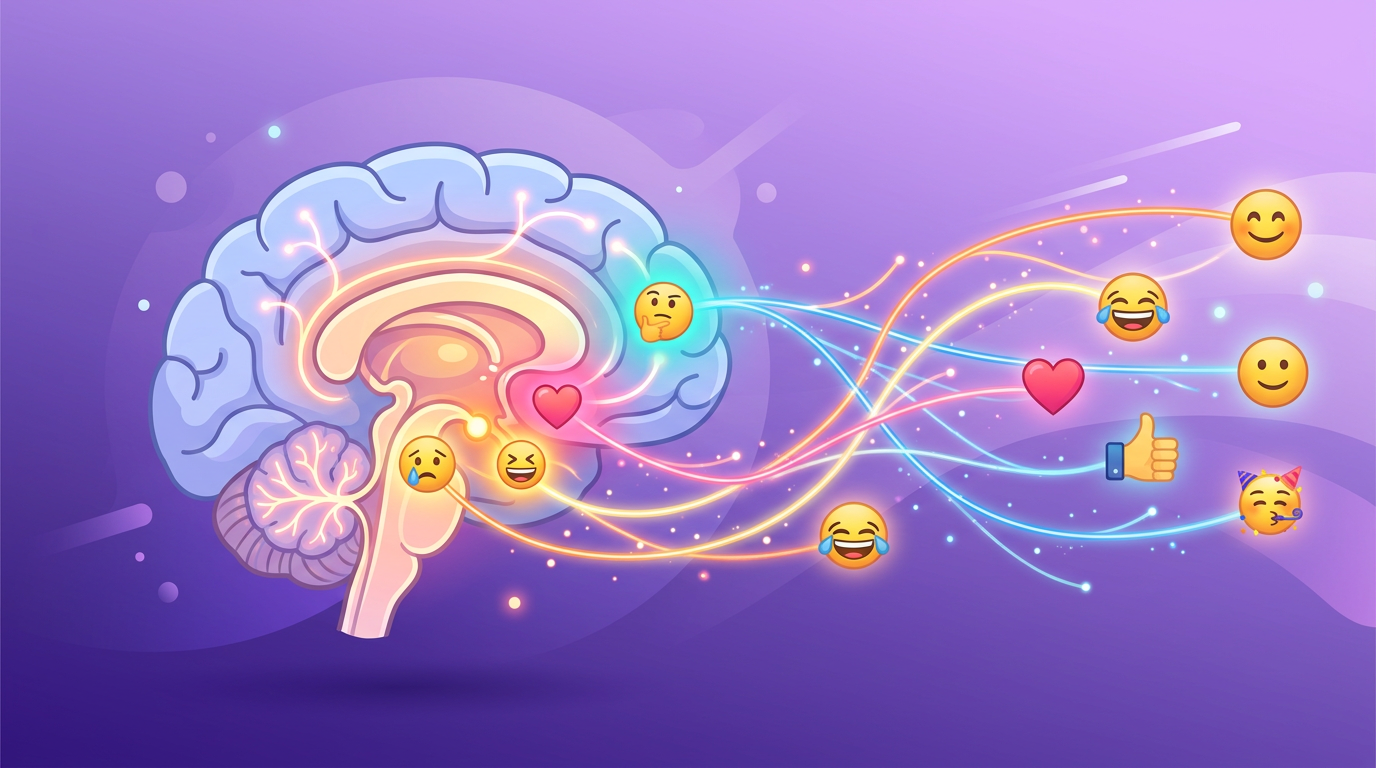
When you see a 😊, something happens in your brain that you probably don't notice. The same neural pathways that activate when you see an actual human smile light up when you see a smiley emoji. Your brain, in a very real sense, treats emojis like faces. And that simple fact explains a lot about why these tiny pictographs have become essential to modern communication.
Your Brain on Emojis
Neuroscientists at the Australian Centre for Excellence in Electromaterials Science discovered that our brains process emojis using the same occipitotemporal regions responsible for facial recognition. When participants in their study viewed :-) or 😊, fMRI scans showed activation patterns remarkably similar to those triggered by photographs of real human faces.
This isn't learned behavior from growing up with smartphones. It's a fundamental feature of human cognition: we are hardwired to seek and interpret faces. Emojis exploit this mechanism, which is why a simple yellow circle with two dots and a curve can make you feel genuinely warmer about a message.
The Emotional Gap in Text
Written language has always had an emotional bandwidth problem. In face-to-face conversation, only about 7% of emotional meaning comes from the words themselves, according to Albert Mehrabian's widely cited communication research. The rest comes from tone of voice (38%) and body language (55%).
Strip all of that away, as text messaging does, and you're left trying to convey the full spectrum of human emotion through words alone. Emojis restore some of that lost emotional bandwidth. They function as digital body language, providing context that words can't always carry.
Consider how the meaning shifts:
- "Sure": Could be agreement, could be passive annoyance
- "Sure 👍": Clear, positive agreement
- "Sure 😒": Reluctant compliance
- "Sure! 😂": Amused, light-hearted agreement
Same word, four completely different emotional meanings, all decoded instantly.
The Negativity Bias Problem
There's a well-documented phenomenon in digital communication called the "negativity bias of text." Readers tend to interpret neutral text messages more negatively than the sender intended. A straightforward "Got it" can read as curt or dismissive, even when the sender meant it cheerfully.
Emojis counteract this bias. A study published in the journal Computers in Human Behavior found that messages containing positive emojis were rated as significantly warmer and more sincere than identical messages without them. Emojis essentially act as emotional insurance, making sure your intended tone arrives intact.
Mirror Neurons and Emoji Empathy
Mirror neurons are brain cells that fire both when we perform an action and when we observe someone else performing the same action. They're central to empathy, helping us feel what others are feeling.
Research suggests mirror neurons respond to emojis too. When you send someone a 😢 in response to bad news, the recipient's brain may actually simulate a small empathetic response, as if they were seeing real concern on your face. This is why emoji reactions in group chats feel satisfying: they create a sense of shared emotional experience that text alone struggles to achieve.
Why We Remember Emoji Messages Better
Dual coding theory, developed by psychologist Allan Paivio, proposes that information encoded both verbally and visually is remembered better than information encoded in only one form. Emojis activate both language processing and visual processing centers simultaneously.
This has practical implications. Marketing messages with emojis show higher recall rates. Educational materials incorporating emoji-like visual aids improve retention. Even legal documents with emoji evidence tend to be more memorable to jurors.
The Personality Effect
Research from the University of Rochester found that people who use emojis are perceived as more agreeable and more open to new experiences. This isn't just correlation. The act of choosing and sending an emoji requires a form of emotional intelligence: reading the situation, selecting the right symbol, and anticipating how it will be received.
Interestingly, emoji use patterns can predict personality traits with surprising accuracy. Extroverts tend to use more emojis and more varied emojis. People high in agreeableness prefer positive emojis. Those high in neuroticism use more negative emojis but also more emoji diversity overall.
The Limits of Emoji Communication
Emojis aren't a perfect system. Ambiguity is a real issue, since the 🍑 emoji means very different things in different contexts. Cultural interpretation varies significantly. And over-reliance on emojis can actually reduce perceived competence in formal settings.
There's also the generation gap. Older users tend to use emojis literally (🙂 means "I'm smiling"), while younger users layer irony and subtext onto them (🙂 can mean "I'm annoyed but being polite about it"). This mismatch can lead to genuine miscommunication.
The Bigger Picture
Emojis succeed because they align with how our brains naturally work. We evolved to read faces, to seek emotional context, and to communicate through multiple channels simultaneously. Digital text stripped all of that away, and emojis brought it back, imperfectly but effectively.
They're not dumbing down language. They're enriching it. Every time you add a 😊 to a message, you're leveraging millions of years of evolved social cognition to make sure your words land the way you mean them to. That's not trivial. That's communication working exactly as it should.