The Real Meaning Behind 15 Misunderstood Emojis
May 8, 2026 · Bas Hennekam
In 2023, a Canadian farmer was ordered to pay $82,000 in damages after a court ruled that his thumbs-up reply 👍 to a contract counted as legal acceptance. He insisted he meant "I got your message." The judge disagreed. That single emoji, sent in seconds, ended up costing him a year's worth of grain revenue. It is the clearest reminder that emoji meanings are slippery, and that the gap between what we send and what someone reads can be much wider than we think.
This guide walks through 15 of the most commonly misunderstood emojis, what they actually mean today, and where the misreads tend to happen.
Why Emoji Meanings Drift
Unicode defines emojis by their official name and visual design, not by social meaning. Once an emoji enters the wild, its meaning belongs to the people using it. That is why 💀 stopped meaning "death" almost everywhere except cybersecurity threads, and why 😭 now signals laughter more often than tears. Drift is faster than ever, accelerated by TikTok, generational adoption, and platform-specific design quirks.
The Innuendo Set
These three are the most famous example of meaning shift. The original Unicode names are matter-of-fact, but the social meaning is now anything but.
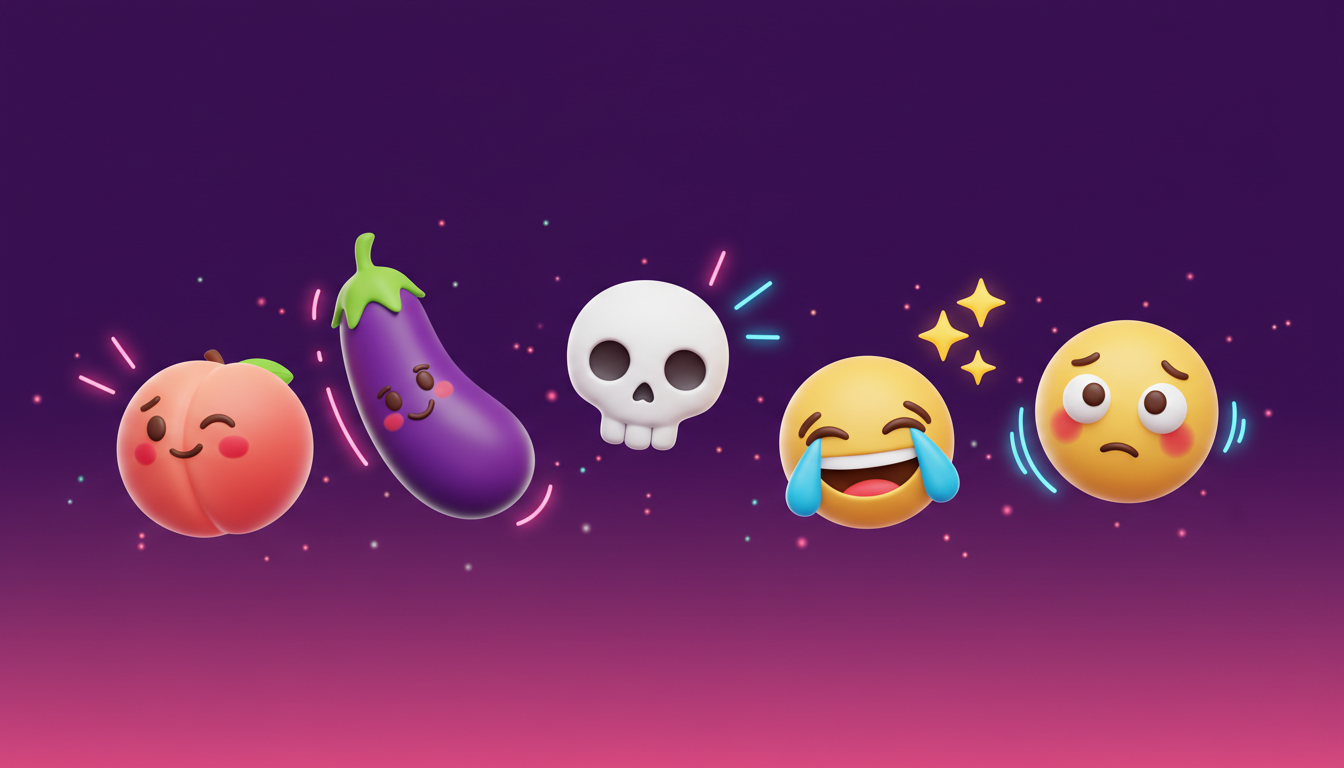
- 🍑 Peach Originally a piece of fruit. Now overwhelmingly a stand-in for a butt, especially in flirtatious or suggestive contexts. Apple briefly redesigned it to look more like actual fruit in 2016 and faced enough backlash to revert within a week.
- 🍆 Eggplant Same story. Officially an aubergine, in practice almost never about cooking. If you genuinely need an eggplant in a recipe message, consider the broccoli 🥦 or carrot 🥕 instead.
- 🍒 Cherries Less universal but increasingly tied to the same suggestive shorthand among Gen Z, especially paired with other fruit emojis.
If you are messaging a colleague or client, treat all three as off-limits unless you are running a literal grocery list.
Emotional Plot Twists
The biggest semantic flip in emoji history happened to the laughing emoji and its successors.
- 😂 Face with Tears of Joy Once the universal laugh emoji, declared "uncool" by Gen Z around 2020. Still dominant among millennials and older audiences.
- 😭 Loudly Crying Face Now functions as the new laughing emoji for Gen Z. The visual implication is "I am crying because I am laughing so hard." Genuine sadness uses 🥺 or 😔 instead.
- 💀 Skull Means "I am dead from laughing," not literal death or threat. Common in dark humor and reaction memes. Use with caution in formal contexts where it can read as ominous.
Faces That Mislead
A few facial emojis carry meanings that are hard to read from the picture alone.
- 🙃 Upside-Down Face Looks playful, almost always carries a hidden edge: passive aggression, sarcasm, or "everything is fine and also it isn't." Almost never sincere positivity.
- 😬 Grimacing Face Reads as an awkward smile, but the modern usage is "yikes." It signals secondhand embarrassment more than nervousness.
- 🥲 Smiling Face with Tear A relatively new emoji (2020) capturing bittersweet emotion: laughing through a hard moment, gratitude that aches, the ache of nostalgia. Not just "I am sad."
Friendly-Looking Threats and Polite-Looking Threats
- 🙏 Folded Hands The most contested emoji in recent years. Was it prayer? A high-five? Just "thank you"? Apple officially calls it "person with folded hands" and notes both prayer and gratitude as valid. Most people now use it as a polite "please" or "thanks." High-five is mostly retired.
- 👍 Thumbs Up Reads as supportive in older audiences, dismissive or hostile among Gen Z, who interpret a single 👍 reply as a brush-off. The court case at the start of this article shows how seriously even institutions can take it.
Cross-Cultural Misreads
Some emojis change meaning at the border.
- 👌 OK Hand Means "okay" in most English-speaking cultures, "money" in Japan, and is read as deeply offensive in Brazil and several Mediterranean countries. It has also been co-opted as a hate symbol in some online subcultures, leading to careful avoidance in professional settings.
- 🤘 Sign of the Horns Rock and roll in the United States. In Italy, it implies infidelity. Context matters.
Sarcasm in Disguise
Two emojis are now almost exclusively sarcastic, despite looking earnest.
- 🤡 Clown Face Self-deprecation, especially the phrase "feeling like a clown" after being wrong, fooled, or naive. Rarely used in genuine humor.
- ✨ Sparkles When wrapped around a phrase like ✨special✨, sparkles sarcastically emphasize that something is, in fact, not special at all. Genuine excitement uses 🎉 or 🤩.
Underused Boredom and Warning Signals
- 😴 Sleeping Face Less about literal sleep, more about declaring something boring. "This meeting has me 😴."
- 🚩 Triangular Flag Almost entirely repurposed as a relationship warning in dating contexts. A single 🚩 means "watch out, that behavior is a problem."
The Takeaway
Emoji literacy has become a soft skill, especially in mixed-generation teams and cross-cultural communication. The safest move is not to memorize a fixed dictionary but to read the room: who is the audience, what platform is the conversation on, and what tone do recent messages set. When in doubt, write the word out, or pick an emoji whose meaning has not drifted (🎉 ❤️ 👋 still mean what they look like).
Emojis will keep evolving faster than any reference can track. The ones in this article will probably mean something else again by 2028. The point is not to keep up perfectly, it is to stay curious about how a 12-pixel image can change in meaning faster than the languages we built it to support.