The Melting Face Emoji 🫠: What It Really Means Online in 2026
August 21, 2026 · Bas Hennekam
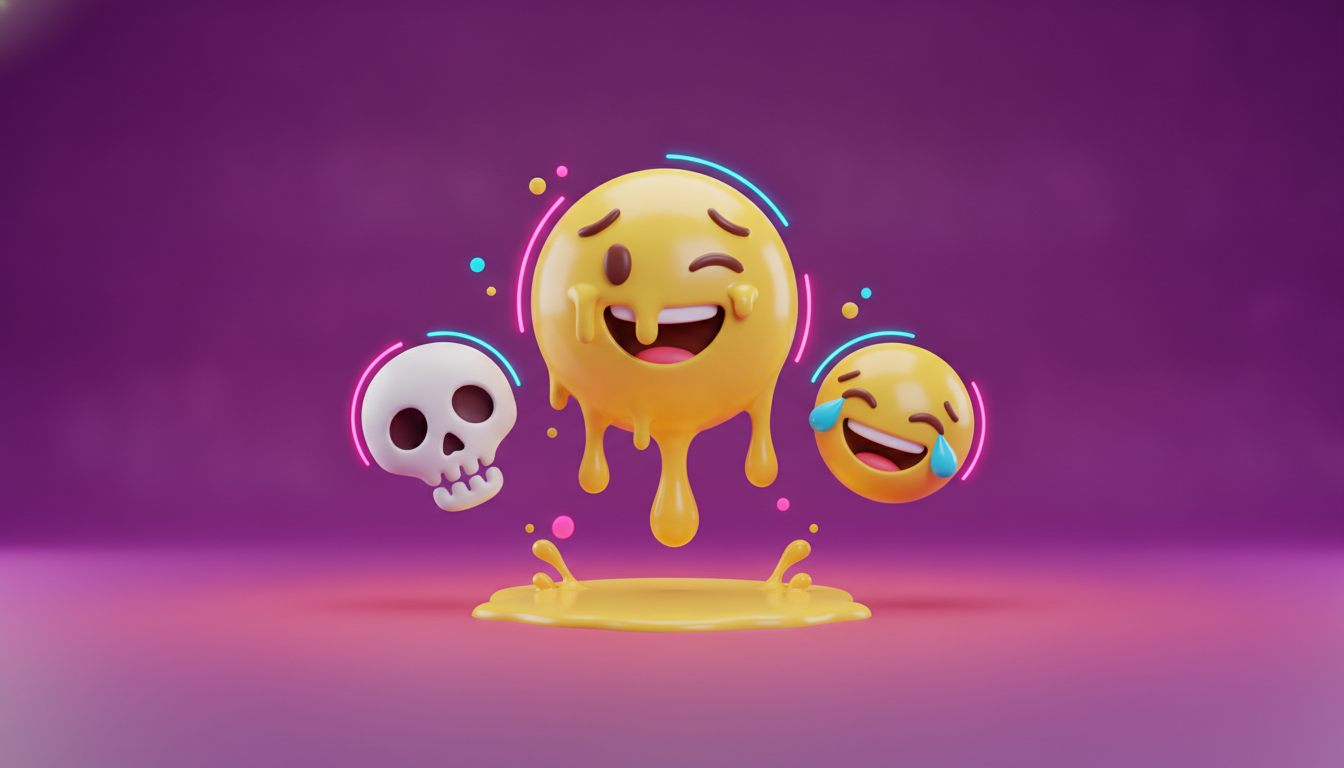
Someone posts something wildly chaotic in the group chat: an outfit that clearly wasn't planned, a work email sent to the wrong person, a plan falling apart in real time. The reply that lands hardest is not laughter or shock. It is 🫠, a face quietly dripping into a puddle, saying without a single word: I see exactly how unhinged this is, and I am choosing to do nothing about it.
That is the modern job of the melting face emoji. Introduced in Unicode 13.1 back in 2020 with a literal meaning close to heat exhaustion or embarrassment, it has been almost entirely reinterpreted by internet culture into a very specific flavor of self-aware surrender: acknowledging chaos, awkwardness, or absurdity while making a conscious decision not to fix it, escape it, or even react to it properly.
From Heat Emoji to Emotional Shrug
When 🫠 first shipped, most style guides described it plainly: a face melting from heat, useful for "it's too hot outside" or straightforward embarrassment, roughly a step up from 😅. That literal reading still exists in weather-related posts and the occasional heatwave meme.
But somewhere between 2021 and 2023, the emoji picked up a second, much stickier meaning on TikTok and X: not "I am hot," but "I know this is deranged and I am doing nothing about it." The shift tracks a broader pattern in emoji culture, where a face with an ambiguous or unusual expression gets claimed by irony-first online humor faster than a face with an obvious, literal meaning. 🫠 had exactly the right ambiguity: melting reads as both "overwhelmed" and "giving up," which made it perfect for describing situations too chaotic to respond to normally.
The Core Meaning Today
Strip away the context and 🫠 in 2026 usually communicates one of three closely related ideas:
- Conscious non-reaction. Something ridiculous, cringe, or overwhelming just happened, and instead of addressing it, the poster is opting out entirely. The melting is the opt-out.
- Self-aware embarrassment. Used about one's own behavior, it signals "I know I just did something questionable" without the defensiveness of an excuse or the drama of an apology.
- Overstimulation. Too much is happening at once, socially, emotionally, or logistically, and the appropriate response is to visually dissolve rather than explain.
What ties all three together is restraint. Unlike 💀 (this killed me) or 😭 (I am sobbing, usually from laughing), 🫠 does not perform a big reaction. It performs the absence of one, which is exactly why it reads as more knowing and slightly more detached than its louder cousins.
Where It Shows Up Most
A few recurring patterns explain most of the emoji's real-world usage:
- Group chat chaos: Dropped alone in reply to a screenshot, a plan change, or a confession, with zero further comment expected or wanted.
- Self-deprecating captions: Paired with a caption about a bad decision, a missed deadline, or an awkward interaction, functioning as a built-in shrug.
- Workplace-adjacent Slack culture: In slightly more professional but still informal channels, it has become a lower-stakes way to acknowledge "this is a mess" without sounding like a complaint.
- Dating app screenshots: A common reaction to a bad opener or an unhinged message, often stacked with 💀 for extra emphasis.
That last pattern points to something worth noting: 🫠 rarely travels alone anymore. It is increasingly used as a modifier rather than a standalone statement, softening or complicating whatever emoji sits next to it.
Melting Face vs the Rest of the Overwhelmed Lineup
Emoji culture has no shortage of "I cannot deal with this" options, but each one carries a distinct emotional register. 😭 signals loud, often positive overwhelm, closer to laughing until it hurts. 💀 signals something was so funny or absurd it metaphorically ended the poster. 😐 signals flat, deadpan detachment with no melting involved. 🫠 sits in a narrower lane between all three: it carries real emotional weight (something actually happened) but processes that weight through resignation instead of laughter or shutdown.
That specificity is part of why the emoji has held its meaning for several years now, unusually long by internet-slang standards. Broader, vaguer reactions tend to drift or get replaced quickly. A narrower one with a clear emotional job tends to stick around, the same durability pattern seen with other precisely defined reaction emoji.
Using It Without Getting It Wrong
- Match the stakes to the melt. 🫠 works best for social or logistical chaos, not for anything genuinely serious. Using it in response to bad news reads as dismissive rather than relatable.
- Let it replace words, not add to them. The emoji does its best work standing alone or with minimal caption. A long explanation next to it undercuts the "I am not going to unpack this" energy that makes it land.
- Watch the generational gap. Readers unfamiliar with the ironic usage may still interpret it literally as "I am too hot" or "I am extremely embarrassed," so context matters more here than with more universally understood reaction emoji.
- Stack sparingly. One 🫠 communicates plenty. Piling on several in a row shifts the tone from wry detachment toward genuine distress, which is usually not the intended message.
What Comes Next
Reaction emoji built around a specific emotional register, rather than a single viral clip or moment, tend to age well, and 🫠 fits that category. Expect it to keep functioning as internet culture's go-to symbol for chaos acknowledged but not addressed well into 2027, with continued use as a modifier alongside other reaction emoji rather than fading into a single-purpose meme. For now, it remains one of the most efficient ways to say "I saw that, I have no notes, and I am simply going to dissolve here" without typing a single word.