Diwali Emoji Guide: The Diya, the Fireworks, and Every Symbol Explained
September 25, 2026 · Bas Hennekam
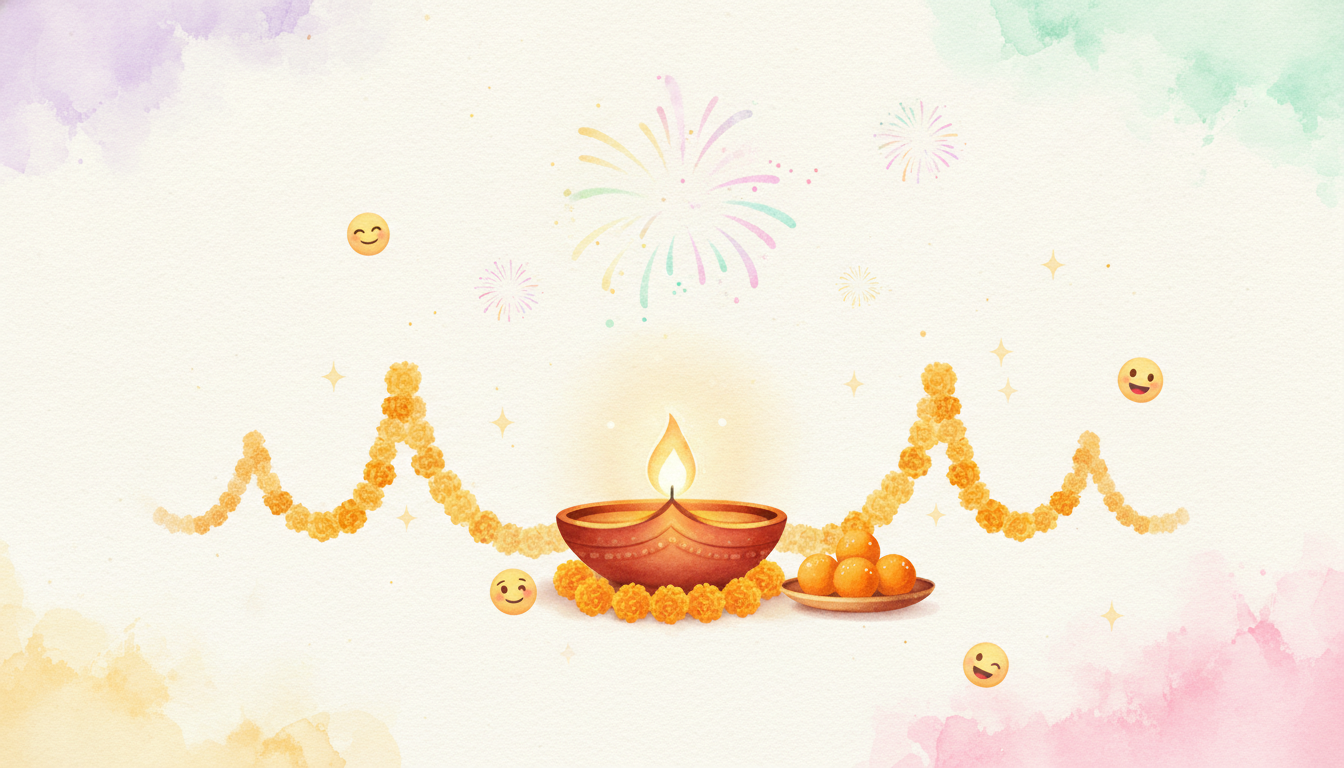
Diwali falls on November 8 this year, and if your messages are not already lighting up with 🪔✨🎆 by the first week of November, you are behind. The Festival of Lights is celebrated by more than a billion people worldwide, spanning Hindu, Sikh, Jain, and Buddhist communities across dozens of countries, and it produces one of the most visually distinct emoji vocabularies of any holiday on the calendar. Unlike Christmas or Halloween, Diwali does not lean on a single dominant icon. It runs on a small constellation of symbols that only make sense together, and getting them right matters if you want a greeting to actually read as festive rather than generic.
The Diya Lamp Is the Emoji That Started It All
The oil lamp emoji 🪔 is the closest thing Diwali has to a dedicated icon, and it is a relatively recent addition. Unicode added it in version 12.0 back in 2019, following years of requests from users who had been improvising with candle emojis or plain text. The diya is a small clay lamp filled with oil and a cotton wick, lit in homes and temples throughout the five days of the festival to symbolize the victory of light over darkness and good over evil, the central theme running through every Diwali story and ritual.
That single symbolic thread is why 🪔 anchors nearly every Diwali greeting, no matter which of the five festival days you are marking:
- Dhanteras: the opening day, focused on prosperity and often paired with 💰 or 🛍️
- Naraka Chaturdashi (Choti Diwali): the smaller lead-up day, frequently shown with 🕯️
- Lakshmi Puja: the main event, when 🪔 usage peaks alongside 🙏 and ✨
- Govardhan Puja: a day of gratitude, often illustrated with 🐄 or 🍛
- Bhai Dooj: closing the festival with a focus on siblings, commonly paired with 👫 or 💝
Fireworks, Sparkles, and the Rest of the Toolkit
If the diya carries the meaning, the fireworks carry the energy. 🎆 and 🎇 dominate Diwali content because the festival's evening celebrations are genuinely built around fireworks and firecrackers in most regions, alongside strings of string lights decorating homes and streets. The sparkle emoji ✨ works as a lighter, everyday shorthand for the same idea, useful when a full fireworks burst feels like too much for a casual message.
Beyond light and fire, four other emojis round out the standard Diwali set:
- 🍬 and 🧁-style sweet emojis for mithai, the boxed sweets exchanged between families and neighbors as a core part of the tradition
- 🌼 and 💐 for marigold flowers, used in rangoli patterns and doorway garlands
- 🕉️ for the Om symbol, appropriate in more devotional or religious-toned messages
- 🙏 for the greeting and blessing gesture that opens and closes most Diwali wishes
A typical greeting text stacks two or three of these rather than one: "Wishing you a Diwali full of light and sweetness 🪔✨🍬" reads as considered, while a single lonely 🪔 can feel like an afterthought.
Why This Season Is Different From Other Holiday Emoji Moments
Diwali emoji usage has a distinct shape compared to Christmas or New Year content. Search interest for Diwali-related emoji combinations typically climbs sharply in the two weeks before the festival date and falls off within days after, a much sharper spike-and-drop pattern than the slow multi-week build seen around Christmas. That compressed window means brands, community accounts, and messaging platforms tend to ship Diwali-specific stickers, reaction packs, and keyboard shortcuts on a tight timeline right before the date rather than weeks in advance.
A few numbers worth keeping in mind heading into November:
- Diwali is a recognized public or optional holiday in more than a dozen countries, including India, Nepal, Sri Lanka, Singapore, Malaysia, Fiji, and Trinidad and Tobago.
- WhatsApp and Instagram have both shipped dedicated Diwali sticker packs in recent years, arriving consistently in the final week of October.
- The diya lamp 🪔 is now supported across every major platform, unlike some newer culturally specific emoji proposals still waiting on full rollout, which makes it a safe, universally renderable choice for cross-platform greetings.
Getting the Combination Right for Marketing and Messaging
For brands and community managers, the difference between a Diwali post that lands and one that feels like a token gesture usually comes down to specificity. Generic "happy holidays" messaging with a random sparkle emoji reads as an afterthought during a season when audiences are used to seeing the full visual language: diya, marigold, sweets, and fireworks working together. E-commerce and email marketing accounts that timed a Diwali campaign around the diya and sweets combination rather than fireworks alone tend to see it land as warmer and more personal, since those two symbols carry the home-and-family side of the festival rather than just the celebratory noise.
For personal messages, the safest combination remains simple: 🪔 for the meaning, ✨ or 🎆 for the energy, and 🍬 or 🌼 to round out the warmth. Stack two or three, skip the rest, and the greeting will read as intentional rather than copy-pasted.
What to Watch as November Approaches
Expect Diwali emoji and sticker activity to follow its usual tight curve this year, with the real spike landing in the first week of November rather than spreading out earlier. Keep an eye on whether any of the newer Unicode 18.0 additions, like the lighthouse or the extra skin-tone options landing across late 2026, end up getting adopted into Diwali visual content once they reach keyboards. For now, the core five-symbol set 🪔🎆✨🍬🙏 remains the reliable choice, tested across years of festival greetings and still the fastest way to signal that a message actually understands the occasion.